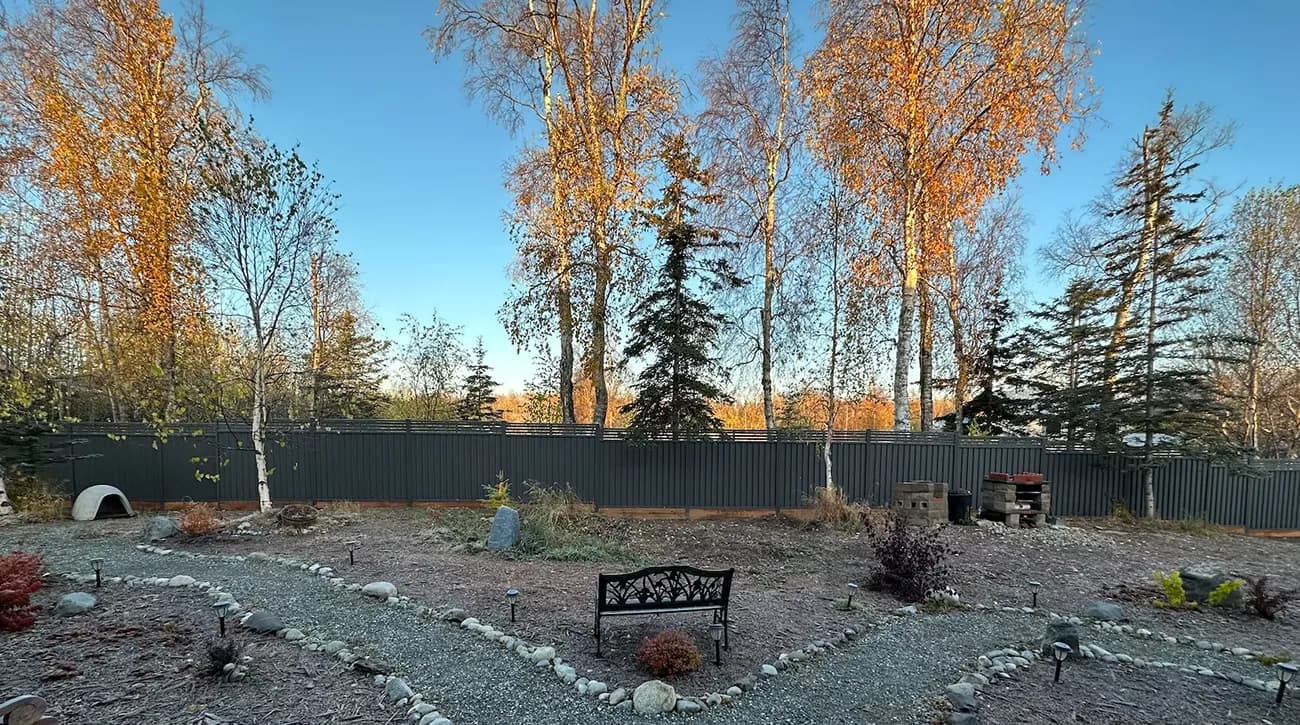
Single Color Steel Privacy is Perimtec’s coordinated full-privacy steel option, offered in a standard 6H x 8W configuration. This buyer guide focuses on deciding whether that format, appearance, and ownership profile fit your scope—not duplicating the complete product specifications, colors, components, and applications.
The system is most useful when full privacy and a coordinated steel appearance matter more than broad material mixing.
Full visual screening
A solid coordinated steel system can work well where the buyer wants to block sight lines rather than simply define an edge. That makes it useful for property lines, backyard privacy, equipment areas, service zones, and commercial screening layouts where visual coverage is the primary purpose.
Coordinated appearance
The posts, framing, and steel infill are intended to visually read as one system instead of several separate materials assembled together. Buyers who prefer a unified metal surface often choose this direction because the fence does not introduce wood-look, vinyl, composite, or decorative board contrast.
Lower recurring upkeep than stained wood
Single Color Steel Privacy avoids the normal recurring stain-and-seal cycle associated with exterior wood privacy fences. It should still be cleaned, inspected, and cared for as an exterior product, but the buyer is not planning around periodic wood staining as a core ownership task.
Straightforward system selection
One standard 6H x 8W configuration reduces some product-selection complexity because the buyer is not choosing among many frame widths, infill materials, or privacy styles. It does not eliminate project planning: gates, corners, end posts, grade changes, concrete mounting, and freight still need to be confirmed.
Single Color Steel Privacy vs Stained Wood
A fair cost and ownership comparison should use a medium-grade stained wood privacy fence with a planned finish, not the cheapest untreated wood fence. Low initial wood bids can look attractive when they exclude finish quality, gate complexity, site access, and the future stain-and-seal cycle that many exterior wood fences require.
Initial price depends on labor, local wood prices, freight, gates, site access, finish level, number of runs, and how cleanly the layout works with standard sections. Single Color Steel Privacy can compare favorably on initial cost in many projects, especially when the buyer is already pricing a finished privacy fence rather than a temporary budget enclosure. It should not be assumed to be cheaper in every market, every freight lane, or every layout.
Wood may still win when natural material variation is the buyer’s top priority or when a project intentionally calls for a stained architectural wood look. Single Color Steel Privacy may win when full visual screening, a consistent finish, steel-forward appearance, and reduced recurring staining are higher priorities than natural grain.
Good-fit uses include residential property-line privacy, backyard screening, pool and patio privacy where locally appropriate, multifamily screening, restaurant and hospitality service areas, commercial property screening, and utility or service-area screening where a full-height visual barrier is appropriate.
Equipment, HVAC, utility, and service-area screening should be planned from the actual site conditions rather than from a generic enclosure image. This page uses only images that visibly show the coordinated steel privacy system; applications without an accurate Single Color Steel Privacy image are explained in copy instead of being illustrated with a mixed-material enclosure.
Single Color Steel Privacy vs Steel Frame with Designer Metal
Both directions can create an all-metal privacy appearance, but they solve the decision in different ways. Single Color Steel Privacy uses one standardized coordinated steel direction, has the standard 6H x 8W configuration, and requires fewer separate frame and infill choices. It is generally the more cost-conscious all-metal privacy path when the buyer wants full screening without paying for a broader custom design menu.
Steel Frame with Designer Metal uses the Steel Frame architecture with separate Designer Metal infill. That route allows broader design and configuration choices, but it is usually the more premium option and may be the better choice when customization, a specific Designer Metal look, or configuration flexibility matters more than minimizing material cost.
Neither system is universally better. Choose Single Color Steel Privacy when the standardized steel privacy direction fits the project; compare Steel Frame with Designer Metal when the design goal depends on separate infill selection or a more customized framed-system layout. For a broader view, use the system comparison hub.
Single Color Steel Privacy vs Aluminum Frame
Single Color Steel Privacy uses the standard 6H x 8W format, focuses on full privacy, and pairs coordinated steel framing with steel infill. It is the better fit when the buyer wants a unified all-steel appearance and does not need to choose from multiple horizontal infill styles.
Aluminum Frame sections use a standard 6-foot width and horizontal infill only. The Aluminum Frame path offers more style and infill choices, including privacy, semi-privacy, lattice, trellis, and aluminum-slat directions, with both Standard Aluminum and Commercial Aluminum configurations available.
Compare Aluminum Frame first when broader horizontal design choice matters, when the project needs semi-privacy, or when the buyer is still deciding between framing materials and section widths. Avoid blanket price assumptions; the right comparison depends on layout, options, gates, posts, and freight.
For a preliminary estimate, divide each individual straight run by 8 feet because the standard section width is 8 feet: individual straight-run length ÷ 8 feet = preliminary section count.
A 32-foot straight run begins with approximately 4 sections. A 48-foot straight run begins with approximately 6 sections. A non-even length such as 50 feet does not divide cleanly into 8-foot sections; the layout may need an adjusted end condition, a gate decision, a shortened field condition, or project review before quantities are finalized.
Round-up calculations are useful for early budgeting only. They do not automatically create a correct order, and they do not replace layout review. Final quantities should be confirmed before ordering or quoting because the section count can change after gates, corners, slopes, walls, and mounting conditions are reviewed.
This early estimate does not automatically account for:
Gates
Corners
Separate fence runs
End conditions
Slopes
Concrete mounting
Site obstructions
Local requirements
Custom transitions
Field adjustments
Plan Each Fence Run Separately
Separate runs must be calculated separately. A project with a 24-foot side-yard run and a separate 32-foot backyard run should be planned as two individual runs rather than one 56-foot line because each run has its own start, end, and possible connection conditions.
Runs that do not divide evenly may require layout adjustment, and every run may need its own corner condition, gate location, post planning, wall connection, slope review, or mounting method. Do not invent an exact post quantity until the layout and quote configuration are confirmed.
Account for Gates Before Counting Sections
For a 40-foot fence line with a planned 4-foot gate opening, do not automatically order five full 8-foot sections without first accounting for the gate opening and its post conditions. Gate openings may affect:
Section count
Gate posts
Hardware
Opening dimensions
Transitions
Freight
Project review
Gates, Corners, and Ending Conditions
Before ordering metal privacy fence panels or requesting pricing, identify the conditions that can change section quantities, post requirements, mounting assumptions, and gate planning:
Starting and ending points: Mark the beginning and end of each run so the quote can account for terminal conditions instead of treating the project as one continuous line.
Corners: Inside and outside corners can change post planning and layout flow, especially when two runs meet at different site conditions.
Wall connections: Connections to buildings, masonry, retaining walls, or existing structures need review because they are not the same as a freestanding line post.
Gate locations: Gate openings affect available fence-run length, opening dimensions, gate posts, hardware, and transitions.
In-ground versus concrete mounting: Post setting and <Link href="/fence-mounted-to-concrete/" className="text-link">concrete mounting</Link> require different project review and should be identified before pricing.
Changes in grade: Slopes and grade breaks can affect how sections step, meet the ground, or transition between runs.
Commercial screening conditions: Service yards, dumpsters, utility areas, and other commercial screening layouts may need additional review for access, exposure, gates, and site constraints.
A one-color privacy system creates a large continuous visual surface, so color should be evaluated against the roof, trim, masonry, landscaping, paving, neighboring fences, and surrounding structures. A color that looks subtle on a small screen can feel much stronger when repeated across a long privacy run.
Dark finishes can show dust, pollen, water spotting, and sun exposure differently than lighter finishes. Screen colors are not exact physical color samples, and photos can shift with lighting, camera settings, and monitor calibration.
For larger projects, use consistent current production colors or runs where practical, and confirm current availability before finalizing a quote. Use material samples when relevant to evaluate general color direction, but do not expect exact screen-to-product color matching.
Buyer Misunderstandings to Avoid
Assuming the system is available in multiple standard sizes
Confusing it with Steel Frame using Designer Metal
Assuming it is always cheaper than wood
Comparing it only against the cheapest untreated wood fence
Assuming no maintenance or cleaning is ever required
Forgetting to account for gates
Dividing total project footage without separating individual runs
Assuming posts, gates, freight, and accessories are always included
Ordering before confirming corners, end conditions, and mounting method
Assuming one residential configuration is appropriate for every commercial application
Assuming every metal privacy fence product shown elsewhere is Single Color Steel Privacy
Failing to confirm current color and finish availability
Request Single Color Steel Privacy Pricing When
Request pricing when the standard 6H x 8W system appears to fit, full privacy is the goal, and the buyer prefers one coordinated steel appearance rather than choosing separate decorative infill. Pricing is also the right next step when layout, gates, posts, freight, multiple runs, or commercial screening conditions need confirmation.
Full privacy is the main goal.
The coordinated one-color steel appearance is preferred.
The standard 6H x 8W format works for the project.
Layout, gates, freight, and posts need confirmation.
The project includes multiple fence runs.
The buyer wants a wood-price comparison based on actual scope.
Commercial steel privacy fence screening is being considered.
Compare systems first when the buyer is not yet committed to full privacy, the preferred appearance may involve horizontal composite, vinyl, wood-look, or aluminum infill, or greater configuration flexibility is needed. Comparison is especially useful when Steel Frame with Designer Metal is under consideration or when the correct framing material and section width are still uncertain.
Semi-privacy is desired.
Horizontal composite, vinyl, wood-look, or aluminum infill is preferred.
A 6-foot-wide section or broader section-width comparison is needed.
Greater design flexibility is important.
Steel Frame with custom or Designer Metal infill is being considered.
The buyer is unsure whether Steel Frame, Aluminum Frame, or Single Color Steel Privacy is the best fit.
Answers about size, cost context, upkeep, gates, separate runs, commercial screening, concrete mounting, and when to request project pricing.
What is Single Color Steel Privacy?+
Single Color Steel Privacy is Perimtec’s coordinated steel privacy option for projects that need full visual screening and a unified steel frame and steel infill appearance. It is different from a framed system using a separate wood, WPC, vinyl, or Designer Metal infill.
What size is a standard Single Color Steel Privacy section?+
A standard section is 6 feet high by 8 feet wide, shown in Perimtec’s preferred format as 6H x 8W.
Is it available in other heights or widths?+
Single Color Steel Privacy is offered in one standard 6H x 8W configuration. Do not assume other standard heights or widths are available unless Perimtec confirms them for the current quote or product configuration.
Is Single Color Steel Privacy less expensive than a wood fence?+
In many projects, it can compare favorably with a medium-grade stained wood fence on initial cost when scope and finish quality are similar. It should not be assumed to be less expensive in every market or layout.
Does Single Color Steel Privacy require maintenance?+
It has lower recurring upkeep than stained wood because it does not require recurring staining in the same way. It should not be treated as maintenance-free; normal cleaning, inspection, and care may still be needed.
How is it different from Steel Frame with Designer Metal?+
Steel Frame with Designer Metal uses a separate framed-system architecture and can deliver a related all-metal privacy appearance, but it is typically more expensive than Single Color Steel Privacy and offers different design flexibility.
How is it different from Aluminum Frame?+
Single Color Steel Privacy is a 6H x 8W coordinated steel privacy system. Aluminum Frame uses 6-foot-wide horizontal sections with broader privacy, semi-privacy, lattice, trellis, and aluminum-slat choices.
Can it be used for commercial screening?+
It can be considered for commercial steel privacy fence and metal privacy screening projects, but commercial layouts should be reviewed for gates, posts, mounting, exposure, freight, and project-specific conditions.
How do I estimate the number of sections I need?+
For an early straight-run estimate, divide the fence-run length by 8 feet. A 32-foot straight run begins with about 4 sections, while a 50-foot run does not divide evenly and may need review.
Should separate fence runs be measured individually?+
Yes. Separate runs should be planned individually because each run can have its own start, end, corner, gate, post, and mounting conditions.
How does a gate affect the section count?+
A gate opening changes available fence-run length and may affect gate posts, hardware, opening dimensions, transitions, freight, and project review. Account for the gate before finalizing sections.
Are posts and gates included?+
Do not assume posts, gates, hardware, freight, or accessories are always included. Included items depend on the exact product, layout, order, and quote configuration.
Can it be mounted on concrete?+
Concrete mounting may be possible depending on the layout, posts, site condition, and mounting method, but it should be reviewed before ordering. See Perimtec’s concrete-mounted fence planning guidance.
What colors are available?+
Final color and finish availability should be confirmed at the time of quoting or ordering. Material samples can help buyers evaluate color direction, but screens may not match the finished product exactly.
When should I request project pricing instead of choosing another system?+
Request project pricing when full privacy, a coordinated one-color steel appearance, and the 6H x 8W format appear to fit, but gates, freight, posts, multiple runs, commercial screening, or wood-price comparison need confirmation.